The AI Forge · Advanced · F4
AI-Augmented Software Eng
Building any software with AI: agentic coding, spec-driven development, review discipline
- Duration
- 2 days · 9:00–17:00 each day (13h contact, incl. breaks + lunch)
- Participant level
- Intermediate: regular AI users
- Format
- Instructor-led labs on a real codebase
- Participants
- 8 included · 12 maximum (flexible group size)
- Prerequisite
- Professional software-development experience (no prior module required)
- Ecosystem
- Agnostic: any model provider or stack
- Price
- EUR 7,000 (EUR 250 per extra participant)
- Discovery Session
- On request
Amounts in EUR, excl. VAT.
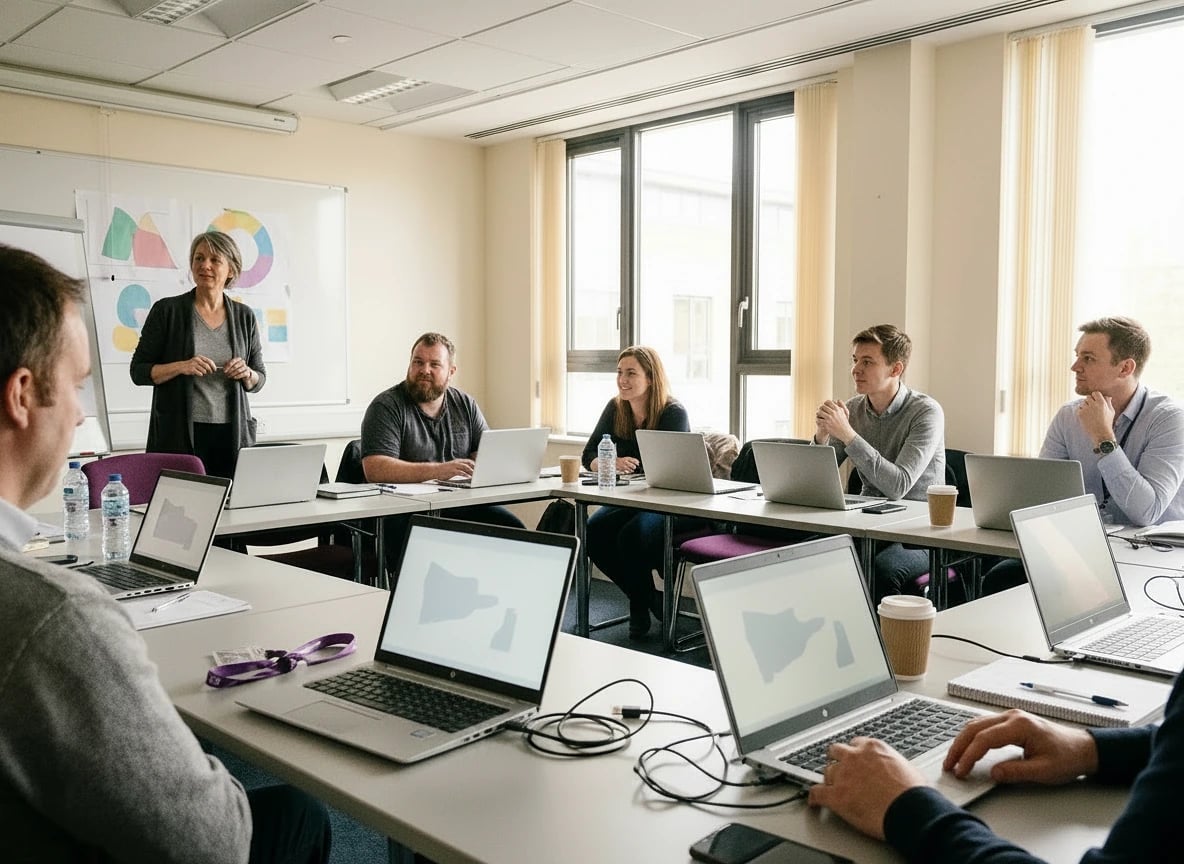 ai-generated
What participants will be able to do
- Use AI coding assistants to write, review, and refactor code faster
- Integrate AI tools into your CI/CD pipeline
- Apply AI for automated code review and test generation
- Measure and report productivity gains from AI coding adoption
Tools & resources
What changes after this module
Developers ship real software faster with AI while keeping quality and control, driving coding agents through spec-driven development, reviewing rigorously, and measuring the impact, skills that hold as the coding tools churn.
Who should attend
Engineers and data professionals. Intermediate: regular AI users.
Programme
This agenda is indicative. Content, sequencing, and examples are adapted to your team's context, tools, and objectives.
Before you start
- A laptop with a working dev environment and an approved AI coding assistant/agent enabled
- Proficiency in the team’s primary language and framework
- Access to a real (non-sensitive) codebase or a substantial starter repo
- A Git repository with branch/PR workflow
- Command-line comfort
| Day 1 | 9:00–10:30 | The shift: from writing to steering: Agent = model + harness; why experienced developers control agents (plan + supervise) rather than “vibe code”, because they own quality Lab: Take a real ticket: the feature you’ll carry across both days: and drive a coding agent through it under active supervision; log where you had to intervene (this log is your Day-2 baseline). |
| 10:30–10:45 · ☕ Coffee break | ||
| Day 1 | 10:45–12:30 | Context engineering for codebases: Giving agents the right context: repo conventions, specs, tests and memory: the durable skill behind good agent output Lab: Set up project context/rules and a spec file, then re-run a task and measure the quality improvement. |
| 12:30–13:30 · 🍽 Lunch break | ||
| Day 1 | 13:30–15:30 | Spec-driven development: Treating the structured spec as the primary artifact from which implementation is derived, verified and governed Lab: Write a spec + validation plan for a feature and have the agent implement it task-group by task-group against the spec. |
| 15:30–15:45 · ☕ Coffee break | ||
| Day 1 | 15:45–17:00 | Lab: ship a feature: End-to-end feature via spec-driven agentic development Lab: Ship a working, tested feature to a branch, driven from your spec. |
| Day 2 | 9:00–10:30 | Review & verification discipline: Reviewing AI-written code, generating and trusting tests, and never merging what you can’t explain Lab: Review an agent’s PR line-by-line, add missing tests, and reject/repair anything unexplained. |
| 10:30–10:45 · ☕ Coffee break | ||
| Day 2 | 10:45–12:30 | AI across the SDLC: Refactoring, debugging, migration, docs and tests with agents: and security review any engineer can now run Lab: Use an agent to refactor a legacy module and run an AI-assisted security review on the result: including a dependency check for hallucinated or unpinned packages. |
| 12:30–13:30 · 🍽 Lunch break | ||
| Day 2 | 13:30–15:30 | Team practices & guardrails: Prompt/spec libraries, PR conventions for AI work, approved-tool policy, and where autonomy is bounded Lab: Draft your team’s AI-engineering guardrails and a reusable spec/prompt template, and apply them to a second task. |
| 15:30–15:45 · ☕ Coffee break | ||
| Day 2 | 15:45–17:00 | Measuring impact & wrap: Throughput vs quality; what to measure so speed doesn’t become rework Lab: Define your AI-engineering metrics (cycle time, review findings, defect rate) and baseline them against your Day-1 intervention log: measured, not perceived. |
Deliverables
- A shipped, tested feature built spec-first
- Reusable spec + project-context template
- Team AI-engineering guardrails + PR conventions
- AI-assisted security-review checklist
- AI-engineering impact metrics baselined
Interested in running this module for your team? Get in touch and we'll tailor the format, dates, and delivery to your context.
Request this trainingYour trainer
Working software engineer; daily agentic-coding practitioner across real codebases
Discovery Session
We also offer a Discovery Session: a 3-hour introduction to the core concepts, with a hands-on exercise, on request, for groups of 5 to 15.
3 hours · From €3,500 · Groups of 5 to 15 - On request
Request a Discovery SessionFrequent questions
Can modules be taken individually?
Yes. Every module stands alone at a fixed price, and every module counts toward a programme if you continue.
Where does training happen?
At your premises or remote, on your dates, for private cohorts. Open sessions run on a fixed monthly calendar.
Which AI tools do you train on?
Yours. Every module ships in four ecosystem editions and runs its exercises on your real stack.
Who delivers?
Inforca's senior consultants and trainers. Flagged modules and the executive track are delivered at senior-expert level.
Discuss this module in a First Call: fit, dates, and the path around it.
No commitment · our team responds within one business day